


Aug 5,2026
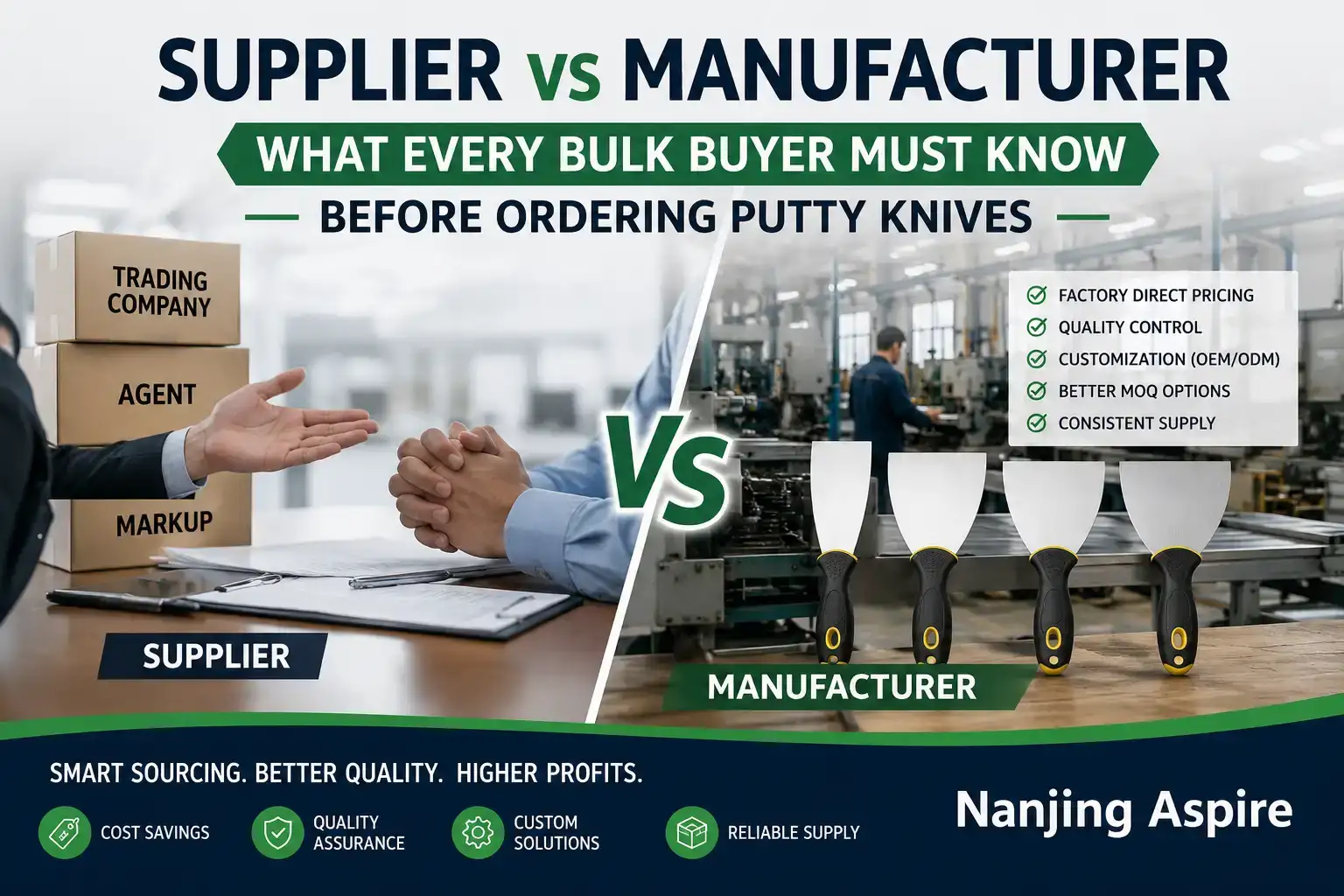
Sourcing high-performance putty knives for your retail store or hardware brand requires you to make smart choices. When you search for bulk stock, you will come across many different sellers. However, you must realize that a professional putty knife supplier might not own a single stamping press or production line. Many of these sellers are simply buying low-cost scrapers from local workshops, adding a large markup, and selling them to you. This can hurt your business because you pay higher prices for simple scraping tools while risking inconsistent blade tempering. To make a sustainable profit in the hardware market, you must understand the true origin of your putty knife inventory.
A professional putty knife consists of a spring steel or stainless steel blade, an ergonomic handle, and a secure full-tang connection. If you choose the wrong sourcing partner, you might end up with blades that bend too easily, handles that crack under pressure, or steel that rusts quickly on the hardware shelves. A professional painter needs a putty knife blade that has the right balance of flexibility and strength to apply drywall joint compound smoothly. If the blade is too stiff, it will scratch the plaster; if it is too soft, it will not spread the mud evenly. You must learn how to spot these product differences before you sign a purchase contract.
To avoid these costly supply chain mistakes, you need to understand the true differences between trading firms and direct putty knife manufacturers. This guide will explain how your choice affects your profit margins, your customization options, and your overall product quality. Knowing these facts will help you find and negotiate with trusted putty knife manufacturers who can supply you with durable, high-quality scraping tools at factory-direct rates. Choosing a direct source allows you to control the exact thickness of the steel, the HRC hardness rating, and the material of the handle, which protects your brand reputation in the local market.
Understanding who controls the physical production floor is the most critical step in evaluating your B2B hand tool suppliers. The distinct operational models of direct manufacturers versus trading brokers dictate everything from your unit pricing to your final product durability.
A factory is a physical building filled with heavy industrial machinery and skilled workers dedicated to manufacturing hand tools. Inside a real production facility, raw metal coils of 65Mn carbon steel or 304 stainless steel go through automated high-tonnage stamping presses. These presses cut the metal into the classic putty knife blade shapes we see in hardware stores. The metal blades then travel through continuous heat-treatment furnaces where extreme quenching and rapid cooling harden the steel. This precise thermal treatment is critical because it gives the putty knife blade its springiness and prevents it from bending permanently during heavy-duty scraping.
After hardening, the blades move to the automated grinding section. Here, wet-grinding wheels taper the steel from the handle base down to the working edge, ensuring optimal flex. The factory workers then place the finished blades into injection molding machines where hot polypropylene and thermoplastic rubber are molded directly around the full-tang steel structure. This direct molding creates an unbreakable bond between the putty knife blade and the handle. The manufacturer manages every single one of these physical steps under one roof. When you buy from them, you are dealing directly with the team that controls the raw materials and the physical machines.
A trading company does not own a factory building, stamping presses, or wet-grinding machines. These companies are commercial sales offices located in city business districts rather than industrial zones. They hire friendly sales staff who speak excellent English, design beautiful online catalogs, and run booths at major import-export trade fairs. To get their inventory, this supplier signs contracts with several small, independent workshops in the countryside.
When you place an order with a trading company, they do not make the putty knives themselves. Instead, this supplier buys the finished tools from their partner workshops, packs them into cardboard boxes in a separate warehouse, and ships them under their own company name. The trading agent acts as a coordinator between you and the actual makers of the tool. While they make the buying process simple by handling the paperwork, they do not have direct physical control over the workers or the machines making your scrapers.
Financial margins in wholesale hardware distribution depend heavily on eliminating unnecessary layers in the supply chain. Examining how baseline manufacturing costs differ from intermediary markups reveals the hidden drains on your procurement budget.
Your landing price is the total amount you spend to buy each putty knife and ship it to your warehouse door. If you buy directly from a manufacturer, you get the lowest possible unit cost. The factory calculates the exact cost of the spring steel coil, the plastic resin, the machine electricity, and the worker wages, then they add a tiny profit margin to stay in business. They do not have to pay sales commission to any third-party agents, which keeps the price very clean and low.
[Factory Cost] ─────────────────> [Direct Deal] ─────────────────> Lowest Unit Price

[Factory Cost] ──> [Trader's Office Rent] ──> [Sales Commissions] ──> Higher Unit Price
A trading supplier operates on a completely different business model. They must make enough money to cover their expensive office rent, sales staff salaries, trade show fees, and marketing costs. To do this, they add a fifteen to thirty percent markup to the price they get from the workshop. If a direct manufacturer sells a stainless steel joint knife for one dollar, a trading supplier will sell that exact same knife for one dollar and twenty-five cents. For a wholesale buyer ordering ten thousand tools, this small markup means you waste thousands of dollars that could have been your profit.
The minimum order quantity is the lowest number of scraping tools a seller will let you buy in a single shipment. Direct manufacturers have very strict, high minimum limits for each scraper size or custom mold. They might require you to buy at least 500 pieces of the two-inch flexible putty knife and another 500 pieces of the four-inch stiff drywall scraper. They set these high limits because setting up a steel stamping machine or changing the plastic injection mold for a specific handle shape takes several hours of manual labor.
If a manufacturer runs a small batch of one hundred tools, the energy and labor cost to set up the machines will actually exceed the value of the order. A trading supplier can offer much lower minimum limits, sometimes allowing you to buy as few as fifty pieces per size. They can do this because they buy unbranded, generic putty knives in huge bulk from various workshops. They keep these generic tools in a small storage room and slowly sell them to smaller retail shops who cannot afford to buy thousands of pieces at one time.
Maintaining tight specifications across steel thickness, blade temper, and branding elements requires direct access to manufacturing parameters. Here is how direct factory partnerships empower your product line adjustments.
Professional painters and drywall installers are very picky about the flex and material of their putty knives. A direct manufacturer can easily change the exact metal recipe, thickness, and HRC hardness rating for your order. For example, if you want a premium rust-resistant tool, the factory can swap out standard carbon steel for mirror-polished 304 stainless steel. They can also adjust the automated grinding wheels to create a taper-ground blade that is thin and flexible at the tip but thick and strong near the handle.
Factory-Direct:  [Raw Steel Sheet] ──> [Custom Stamping & Grinding] ──> Perfect Blade Flex
Trading Agent:   [Finished Scrapers] ──> [No Modification Possible] ──> Rigid Stock Spec
A trading supplier cannot offer these specific product changes. They buy pre-made, finished putty knives that are already packed in boxes. If you ask a trading supplier to make the blade 0.8 millimeters thick instead of 1.2 millimeters thick, they will almost always refuse. They cannot adjust the grinding machines because they do not own them. They can only sell you the standard, off-the-shelf tools that their partner workshops are already making for the general market.
Building a recognizable hardware brand requires putting your custom logo on every putty knife you sell. A direct manufacturer handles this branding process while they are actually making the tool. They can use high-powered lasers to etch your brand name deep into the metal blade before applying the anti-rust oil. They can also engrave your logo directly into the steel injection molds, which makes your brand name a permanent, raised part of the plastic handle.
A trading supplier has very limited options for branding. Since they receive finished, pre-molded putty knives, they cannot engrave your logo into the plastic or laser-etch the blade during production. Instead, they must use cheap workarounds. They might stick a paper barcode label onto the handle or use a simple rubber stamp with black ink. These cheap logos look unprofessional and will easily peel off or smudge the first time a painter gets drywall mud or water on the tool.
When batch inconsistencies or material flaws occur, your resolution path depends entirely on whether your supplier owns the production line or simply brokers the transaction.
A high-quality drywall putty knife must not rust on the store shelves or snap when a worker uses it to scrape off old wallpaper. To guarantee this quality, direct manufacturers test every single batch of steel sheets they receive from the metal mills. They use specialized Rockwell hardness testers to verify that the steel has a rating between forty-eight and fifty-two HRC. They can easily provide you with official mill test certificates and chemical analysis sheets for your records.
A trading supplier does not have access to these technical testing machines or mill certificates. They buy finished scrapers from different countryside workshops that often use cheap, uncertified scrap metal to keep their costs low. If you buy from a trader, you have no way to trace where the steel came from or verify if the blades will bend out of shape after a single day of work. This lack of quality control can quickly lead to customer complaints and ruin your brand reputation.
If you open a shipping container and discover that hundreds of your new putty knives have loose handles or cracked hanging holes, you need a fast solution. When you buy directly from a manufacturer, the resolution process is very straightforward. The factory manager can walk down to the production line, identify the worker or machine that made the mistake, and fix the issue. They can quickly offer you a cash credit or ship a replacement batch of scrapers because they own the entire process.
Direct Sourcing:  [Buyer Claims Defect] ─────────────────> [Factory Resolves Directly]
Trading Sourcing: [Buyer Claims Defect] ──> [Trader Argues] ──> [Workshop Refuses] ──> [No Solution]
When you file a defect claim with a trading supplier, the process is often slow and frustrating. The trader does not want to lose their small profit margin, so they will try to shift the blame. They might claim that your workers damaged the tools while unloading the container, or they will argue with the third-party workshop about who should pay for the mistake. This back-and-forth communication can take weeks, leaving you with unsellable stock and no refund.
The table below summarizes how direct production manufacturers compare to trading suppliers across core operational metrics for wholesale putty knife procurement.
| Sourcing Feature | Direct-from-Floor Manufacturer | Third-Party Trading Supplier |
|---|---|---|
| Direct Steel Customization | Allows you to choose 304 stainless steel or 65Mn spring steel | Limited to whatever standard steel is currently in stock |
| Blade Grind Control | Can adjust automated grinding machines for custom flex ratings | Can only offer fixed-thickness blades from pre-made batches |
| Handle Material Options | Offers custom wood, single-injection, or dual-color TPR grips | Only offers standard, generic plastic or low-grade wood |
| Logo Permanence | Engraves or laser-etches logos during production processes | Uses paper stickers or simple ink stamps after production |
| Hardness Testing | Performs onsite Rockwell hardness testing on every steel batch | No physical testing facilities or hardness verification |
| Direct Communication | You speak directly to the engineers who run the tool machinery | You speak to sales agents who do not understand production |
Because many trading agents market themselves as primary manufacturers online, knowing how to verify their true operational footprint protects your investment from deceptive sourcing structures.
Many trading suppliers try to look like direct manufacturers by putting photos of smoking chimneys and big warehouses on their homepages. However, you can easily discover the truth by looking closely at their online catalog. A real putty knife manufacturer is highly specialized because the machinery required to stamp and grind spring steel is completely different from the machinery used to make unrelated hardware items. A genuine factory will focus specifically on putty knives, taping scrapers, paint scrapers, and wall joint knives.
If a seller claims to be a factory but their product catalog includes putty knives, safety gloves, paint rollers, hammers, measuring tapes, and screwdriver sets, they are definitely a trading supplier. No single manufacturer has the money or the space to own the specialized stamping machines needed to make all of those different hardware categories. They are simply buying those various items from ten different local workshops and consolidating them into one catalog.
Requesting a custom sample is a great way to test a seller's true identity. If you want a three-inch putty knife with a mirror-polished stainless steel blade and a blue soft-grip handle, ask the seller to make one for you. A real manufacturer has dedicated sample makers and plenty of raw steel coils in their warehouse. They can quickly stamp the blade, polish it, inject the custom handle, and ship the completed sample to your office within a week.
A trading supplier will find this request very difficult. They do not have raw steel sheets or plastic resin sitting in their office. They have to contact their partner workshop and beg them to make a single custom tool. The workshop will usually refuse because they do not want to stop their active machines for a single sample. As a result, the trading supplier will take several weeks to send the sample, or they will try to convince you to accept a standard, pre-made tool instead.
With modern video calling technology, you can easily verify a seller's facility without buying an expensive plane ticket. Ask your sales representative to do a live video tour of their building using their smartphone. Ask them to show you the raw steel storage area, the heavy stamping presses, the heat treatment ovens, the wet-grinding wheels, and the final packaging line.
A real manufacturer will happily agree to this request because they are proud of their machinery and want to show off their production capacity. A trading supplier will make many excuses to avoid a live video call. They might claim that their internet connection is too weak in the industrial area, or they will say that factory policy bans cameras for trade secret protection. These excuses are a clear sign that they only own a small office space with computers and desks.
Your ideal sourcing channel depends heavily on your company's scale, order volume requirements, and inventory distribution goals within the global hardware market.
If you are an established hardware distributor, a high-volume importer, or a brand that supplies professional paint stores, you must work with a direct manufacturer. Your business model depends on offering high-quality tools at competitive prices. If you buy from a middleman, the extra thirty percent markup will make your retail prices too high, and your competitors will easily steal your customers.
By working directly with a manufacturer, you get the lowest possible unit cost and complete control over the production standards. You can make sure that every single putty knife has a blade made of high-grade, tempered carbon steel and a handle that is securely bonded to the metal. This consistency will keep your customers happy and help you build a highly reliable, profitable brand in your local market.
If you are a startup business owner, a small local retail store, or an online seller who is just starting out, a trading supplier can be a helpful partner. When you are small, you do not have the money to buy thousands of pieces of a single scraper size. A trading supplier allows you to buy a small, mixed batch of tools to test the market without spending too much money.
You can buy fifty pieces of a two-inch putty knife, fifty pieces of a three-inch putty knife, and fifty pieces of a joint knife from one source. Even though you will pay a higher price per tool, you save money on shipping because the trader combines all your items into one box. This approach reduces your financial risk while you learn what types of tools your local customers prefer to buy.
In the competitive world of hand tool sales, your sourcing strategy determines your business success. Buying your inventory through a middleman can help you get started with low initial costs, but it also means you lose control over product quality, branding, and long-term profits. Working directly with a physical production facility gives you the power to set your own quality standards, customize your product designs, and enjoy the highest possible profit margins.
By taking the time to verify your supplier's true business model, you can build a stable and highly profitable business. Make sure to ask the right questions, request material certificates, and use virtual audits to confirm who is actually making your putty knives. This extra effort will protect your brand reputation and ensure that your customers always receive durable, professional-grade scrapers that get the job done right.
Building a successful hardware brand requires a supply partner who values quality consistency and clear communication. If you want to expand your retail shelves or launch a private label line of scraping tools, you need to work with a team that controls the entire production process from raw steel sheets to finished putty knives. Our team offers direct factory pricing, certified steel materials, and fully customizable design options to help you stand out in the local market. We understand the physical demands placed on hand tools and build our putty knives to withstand the toughest jobs.
At Nanjing Aspire professionals, we focus on delivering reliable scraping tools that meet the exact demands of professional painters and drywall contractors. We manage every step of production under one roof, giving you full traceability, low production lead times, and worry-free defect resolutions. Contact our export department today to discuss your custom specifications, request physical samples, and secure a profitable supply chain for your business.