


Aug 18,2026
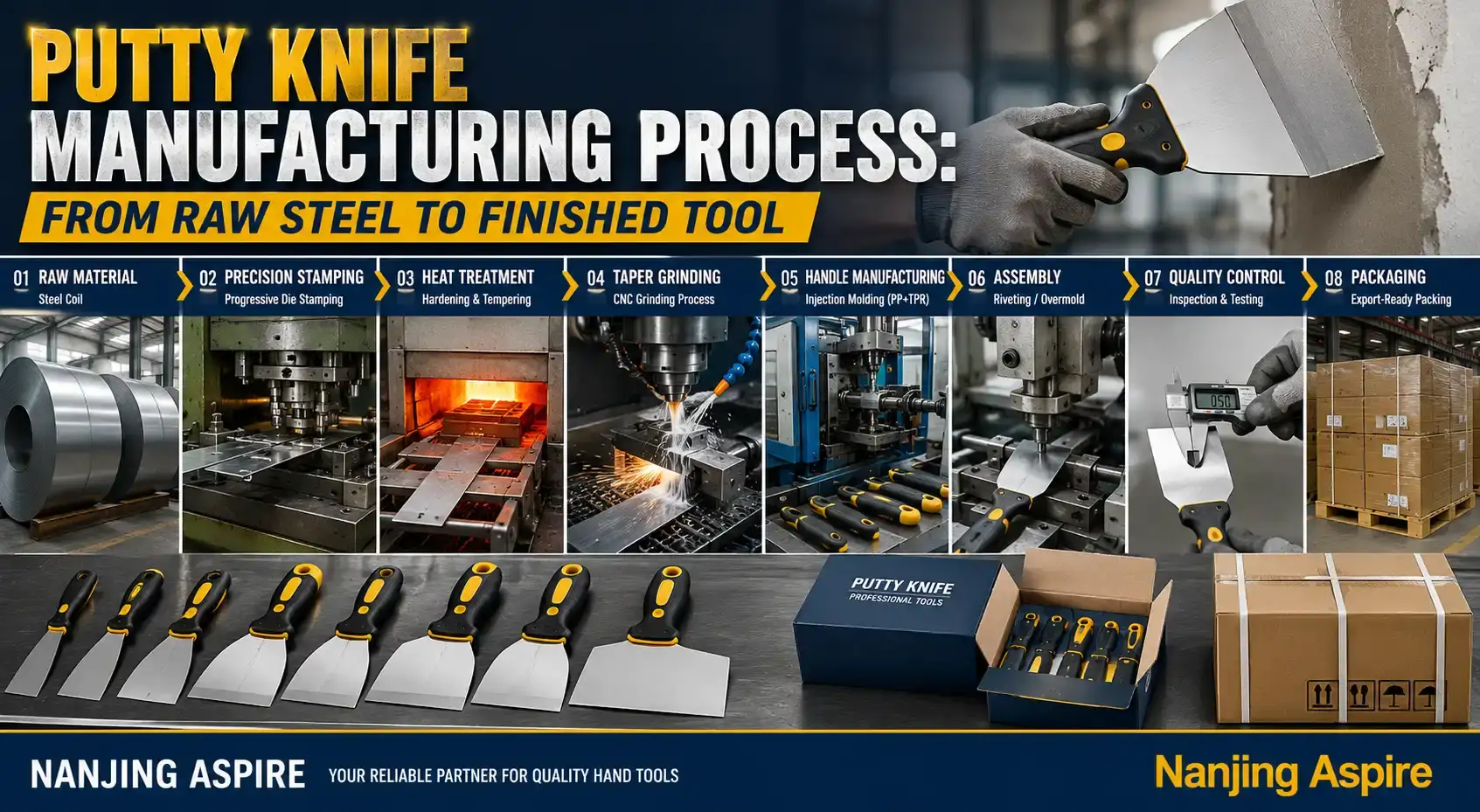
When you import hand tools in bulk, you need to know exactly how your suppliers make them. A putty knife looks like a simple tool with a metal blade and a plastic or wooden handle. However, the actual quality of this tool depends on a highly controlled factory system. If you buy from trusted putty knife manufacturers, you can be sure that every batch of tools has the exact same thickness, strength, and lifespan. This complete guide will take you behind the scenes of the factory floor to show you how workers turn raw steel coils into high-quality scraping and spreading tools.
For wholesale buyers, knowing this step-by-step production method is the best way to check if a factory is reliable. It helps you understand what makes a blade bend nicely without breaking, and why some handles never wobble. When you know these technical details, you can easily spot a good manufacturer and avoid low-quality trading companies. Let us look at the real steps that shape the tools your customers use every day.
Every single putty knife begins its life as a massive roll of raw steel. The type of metal a factory chooses will decide how much the blade can bend, how long it stays sharp, and how well it resists rust. If a manufacturer starts with low-grade metal, no amount of polishing or grinding can fix the final tool.
| Steel Grade | Key Alloys | Best Use Case |
|---|---|---|
| 65Mn Carbon | Manganese, Carbon | High-flex drywall plastering |
| 420 Stainless | Chromium | Rust-free wet area scraping |
| 440 Stainless | High Chromium | Premium professional paint prep |
Most flexible putty knives use 65Mn carbon spring steel. The letters and numbers in "65Mn" stand for the chemical mix of the metal. The "65" means it has about 0.65% carbon, which makes the steel strong enough to hold its shape. The "Mn" stands for manganese, which gives the steel its springy nature.
When a factory receives these steel coils, the metal is still relatively soft and easy to cut. The manganese alloy allows the steel to stretch and bend during the forming stages without cracking. This raw material is highly cost-effective for bulk production, but it must be kept dry because carbon steel can rust easily if exposed to moisture.
For premium markets where tools face wet plaster or humid environments, factories use stainless steel. The 420 and 440 grades contain a high amount of chromium, usually over 12%. Chromium creates an invisible shield on the surface of the blade that stops oxygen and water from rusting the iron underneath.
Stainless steel is harder than carbon steel even before heat treatment. This hardness makes it tougher to cut and stamp, which wears down factory dies and machines much faster. For this reason, stainless steel putty knives have a higher unit cost, but they offer the long-term rust resistance that professional painters demand.
A real factory does not just take the steel mill's word about the quality of the metal. When the raw coils arrive at the warehouse, the quality control team checks the Mill Test Certificate. This document lists the exact percentage of carbon, manganese, phosphorus, and sulfur in that specific batch.
Some factories also use a handheld spectrometer gun. This device shoots a light beam at the steel to verify its chemical makeup in seconds. If the carbon level is too low, the blades will be too soft. If the phosphorus level is too high, the steel will be brittle. Checking these chemicals before production prevents bad batches.
Once the raw steel coil is approved, machines feed the metal into the stamping sector. This is where the flat steel gets its basic shape, including the blade body and the narrow tail called the tang.
High-volume factories use progressive die stamping presses. A progressive die is a long series of cutting teeth inside a heavy press machine. As the raw steel ribbon slides through the machine, the press stamps down repeatedly. With each stamp, the die performs a different action, such as punching rivet holes, cutting the side angles, and clipping the finished blank.
This automated process keeps the blade dimensions extremely accurate. The physical width of a three-inch blade will stay within 0.05 millimeters of the design drawing. This level of consistency is critical for wholesale orders because it means every tool in your shipping container will be identical.
Some small, budget-friendly workshops do not use progressive dies. Instead, they use simple single-stage presses where a worker manually slides the steel plate under the blade puncher by hand. While this method saves on machinery costs, it introduces human error.
Manual feeding often leads to slight shifts in the metal. The rivet holes might be slightly off-center, or the blade shape might be slightly crooked. When you assemble a crooked blade into a handle, the tool will feel unbalanced. Automated feeders eliminate this variance by locking the steel ribbon in place before every punch.
The tang is the hidden part of the metal blade that slides inside the handle. Stamping machines cut this section into specific shapes based on how strong the tool needs to be.
Stamped steel blanks are flat and easy to bend with your bare hands. To make them springy and tough, they must go through a two-step heat treatment process. This is the most scientific part of the entire manufacturing cycle.
Workers load the stamped steel blanks onto a moving metal belt that carries them into an industrial furnace. The temperature inside this furnace is kept between 800 and 850 degrees Celsius for carbon steel, and even higher for stainless steel.
At this extreme heat, the atoms inside the steel shift into a new pattern called austenite. Once the blades reach this temperature, they drop quickly into a bath of controlled oil or water. This rapid cooling is called quenching. Quenching freezes the new atomic structure in place, making the metal incredibly hard but also as fragile as glass.
If you dropped a newly quenched blade onto a concrete floor, it would shatter into pieces. To fix this brittleness, the factory must temper the steel. The quenched blades go into a second, cooler furnace heated to about 350 to 450 degrees Celsius.
This lower heat allows the metal atoms to relax slightly. It relieves the internal stress caused by the rapid cooling bath. Tempering reduces a tiny bit of the extreme hardness but gives the blade its essential springiness. After tempering, the metal can bend repeatedly without breaking or staying bent.
After the blades cool down from the tempering furnace, quality inspectors select random samples for a hardness test. They use a machine with a tiny diamond cone called a Rockwell Hardness Tester. The machine presses the diamond into the blade with a specific force and measures how deep it goes.
| Hardness Range (HRC) | Blade Behavior | Result for the User |
|---|---|---|
| Below 42 HRC | Too Soft | Blade bends and stays crooked |
| 44 to 50 HRC | Perfect Spring | Bends and snaps back straight |
| Above 52 HRC | Too Brittle | Blade snaps under load |
For putty knives, the perfect sweet spot is between 44 and 50 on the Rockwell C scale (HRC). If the test reads below 42 HRC, the furnace was not hot enough, and the blade will bend permanently during use. If the test reads above 52 HRC, the tempering time was too short, and the blade will crack under pressure.
A flat sheet of heat-treated steel cannot spread compound smoothly. It needs a taper, which means the metal must be thicker near the handle and thinner at the working tip. Achieving this transition requires highly accurate grinding machines.
Factories use different grinding styles depending on what the putty knife will do. The two main styles are hollow grinding and flat taper grinding.
Older factories rely on workers holding individual blades against spinning abrasive belts by hand. This hand-grinding method creates a lot of dust and leads to uneven blades. One tool might be thin on the left side, while the next one is too thick in the middle.
Modern OEM factories use computer-controlled (CNC) grinding lines. A robotic arm picks up a blade and feeds it through a series of grinding wheels. Water sprays over the metal to keep it cool so the grinding heat does not ruin the tempered hardness. The computer monitors the wheel wear and adjusts itself to keep the thickness within a hair's width.
Once ground to the correct thickness, the blade has a rough grey surface. To make it look clean and professional, the metal goes through a polishing line.
The handle is the physical link between the user's hand and the metal blade. It must be comfortable to hold, resistant to paint chemicals, and tough enough to survive being dropped on busy construction sites.
Most modern putty knives use plastic handles made through automated injection molding. The factory melts plastic beads and injects the liquid under high pressure into steel molds.
The best handles use a dual-injection process. First, the machine molds a solid core out of Polypropylene (PP), which is a rigid plastic that does not bend or crack under pressure. Then, a second injection molds a layer of soft Thermoplastic Rubber (TPR) over the grip areas. This soft rubber gives the user a non-slip grip, even if their hands are sweaty or covered in wet paint.
For traditional markets, some wholesale buyers prefer wooden handles. Factories make these from dense hardwoods like beechwood or birch because they do not split easily.
The wood blocks go into automated copy lathes that carve them into ergonomic shapes in seconds. After carving, the wood must be thoroughly sanded to prevent splinters. Finally, the handles get a clear lacquer coat. This sealant prevents the wood from absorbing water, which would cause the handle to swell, warp, and loosen its grip on the blade.
Connecting the finished blade to the handle is a critical step. If this joint is weak, the knife will fail quickly, ruining your brand's reputation with retail customers.
| Assembly Method | Key Advantage | Best Tool Type |
|---|---|---|
| Glue Only | Very cheap, clean exterior | Light-duty DIY disposable tools |
| Brass Rivets | Highly secure, classic look | Professional wood-handled knives |
| Direct Overmolding | Waterproof, impossible to pull out | Heavy-duty ergonomic paint scrapers |
The most durable way to connect a blade and a plastic handle is through direct overmolding. In this method, the metal blade tang is placed directly inside the injection molding machine before the plastic is injected.
The hot, liquid polypropylene plastic flows through the stamped holes in the steel tang and solidifies around it. Once the plastic cools, the blade and the handle are locked together as a single solid piece. There are no gaps for water or plaster to get inside, and the blade cannot be pulled out of the handle without destroying the tool.
For wood handles or two-piece plastic handles, factories use compression riveting. The blade tang is slid into a slot in the center of the handle. The worker then lines up the holes in the wood with the holes in the steel.
A machine feeds solid brass or steel pins through the holes and squeezes the ends under high pressure. This flattens the rivets, clamping the handle halves tightly against the metal tang. Real brass rivets are highly valued by buyers because they do not rust when exposed to water-based compounds.
The manufacturing process is not complete until the tools are checked, packed, and secured inside a shipping container. Proper testing at this stage ensures that your shipment arrives in perfect condition.
Before packaging, workers perform a physical deflection test on random tools from the line. They secure the handle in a clamp and bend the blade to a 45-degree angle.
The blade must spring back to a perfectly straight line with zero bend. If the tool has a metal hammer end welded to the bottom of the handle, a machine strikes the weld point with a hammer to ensure the weld does not crack under heavy impact.
To verify that the stainless steel or protective coatings work correctly, factories run salt spray tests. They place several finished putty knives inside a sealed chamber that sprays a hot, salty mist continuously for 24 to 48 hours.
This environment accelerates rust. If a stainless steel blade shows orange rust spots after the test, the chromium levels are too low, or the surface passivation process was flawed. This test is crucial for wholesale buyers who ship goods over wet ocean routes where salty air can destroy unprotected metal.
For long-distance shipping, bulk putty knives must be packed carefully to prevent moisture damage. Every tool typically gets a small plastic sleeve or card to protect the blade surface from scratching.
The tools are then packed into inner boxes, which go into heavy five-layer corrugated cardboard master cartons. To protect the metal from humidity during maritime shipping, factories line the cartons with thick plastic bags and include silica gel packs to absorb moisture.
To summarize, manufacturing a high-quality putty knife is a highly organized process that turns raw materials into durable hand tools. Every phase must be handled with precision to prevent errors in the final product.
By focusing on these manufacturing steps, wholesale buyers can easily evaluate potential suppliers, negotiate accurate technical specifications, and purchase tools that build long-term trust with their customers.
Choosing a reliable partner is the most critical decision for any bulk hand tool importer. Working with a dedicated factory ensures that your putty knives are engineered to the highest performance standards, with full traceability from raw steel coils to the final packed cartons.
At Nanjing Aspire, we believe in open processes and absolute quality. Nanjing Aspire experts manufacture a wide selection of durable drywall and paint preparation tools built to handle demanding professional jobs. If you are ready to upgrade your inventory with reliable, high-performance hand tools, view our wholesale putty knives category and contact our engineering team today to receive a custom OEM production quote.